
Do the boots actually work?
1 October 2026 · Rink Ready
Compression boots reliably make legs feel better. What the research cannot find is any effect on how those legs actually perform the next day.
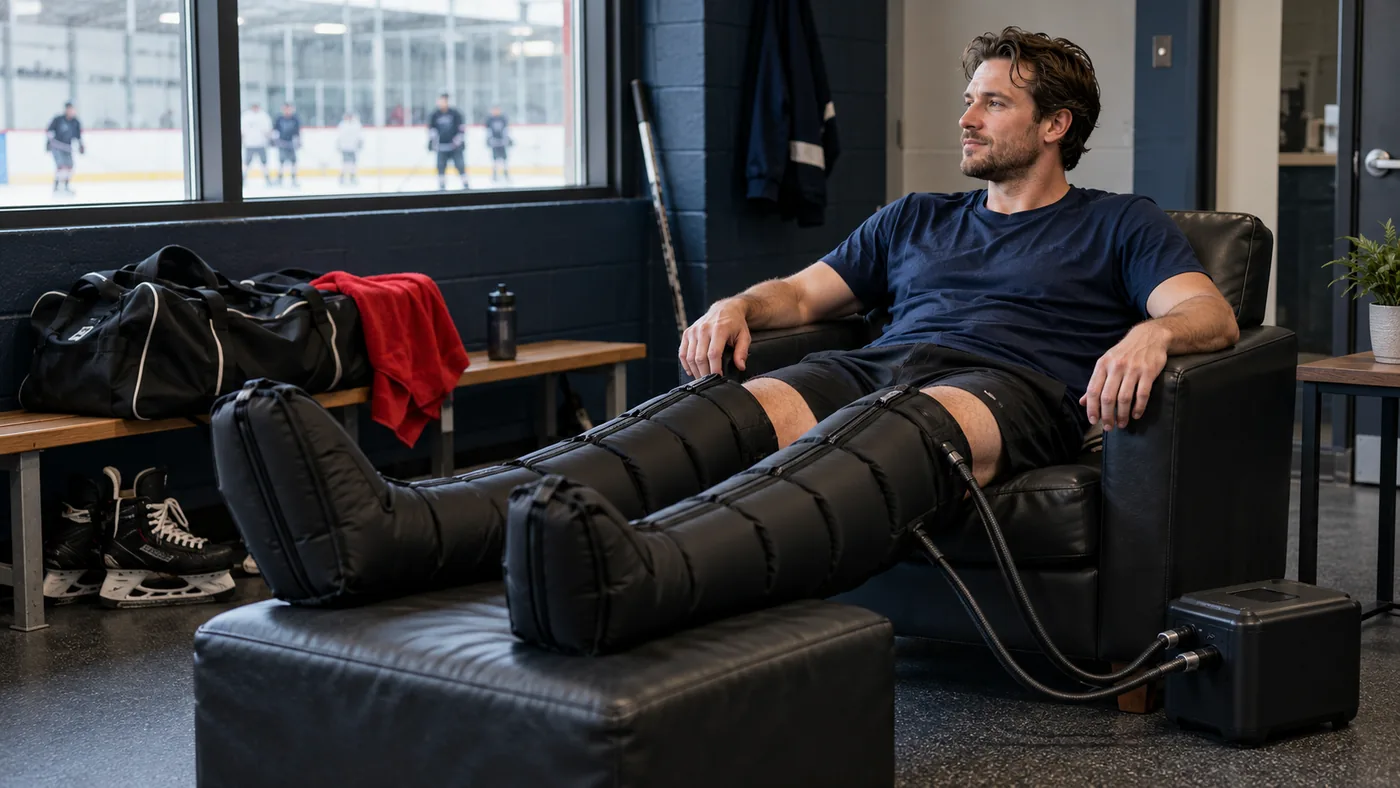
They are in every dressing room now. A player sits against the wall with their legs zipped into a pair of inflating sleeves, phone in hand, looking like they are being prepared for space travel. Somebody's dad asks what they cost. Somebody else says their kid's team is fundraising for a set.
So: do they work?
The honest answer is that it depends entirely on what you mean by "work", and the gap between the two possible meanings is the whole article.
What they are supposed to do
Intermittent pneumatic compression — the technical name — squeezes the limb in a wave, usually from the foot upwards, then releases. The idea is that this pushes blood and lymph back towards the heart, clears the waste products of hard exercise, and brings fresh blood in behind them. Flush the legs out, recover faster, play better tomorrow.
It is a good story. It has an obvious mechanism. The machines even feel like they are doing something, which is not nothing when you are selling one.
What the research actually found
A systematic review and meta-analysis pulled together the studies on lower-limb intermittent pneumatic compression for sports recovery — seventeen studies in the review, fourteen in the analysis itself. It looked at soreness, at muscle function, and at blood markers of muscle damage, measured at several points after exercise.
Here is what it found.
Soreness: yes, sometimes. Straight after treatment, perceived soreness was significantly lower than in the control groups. At ninety-six hours, also significantly lower. At twenty-four, forty-eight and seventy-two hours — the window most people actually care about — the differences did not reach significance.
Muscle function: no. Jump, power and strength were measured immediately after, and at twenty-four, forty-eight and seventy-two hours. Not one of those timepoints showed a significant benefit. Not one.
Muscle damage markers: no. Creatine kinase, the standard blood marker for muscle damage, showed no significant difference at any timepoint.
So the boots did the thing they are designed to do — they made legs feel better — and did not do the thing people buy them for, which is to make legs work better sooner.
It gets more awkward than that
A separate network meta-analysis went wider, comparing ten different recovery modalities in competitive and elite endurance athletes: cold water immersion, whole-body cryotherapy, active recovery, compression garments, electrical stimulation, massage, pneumatic compression, infrared. Sixteen randomised trials, 273 participants.
Its conclusion, in the authors' own words, was that no modality has been shown to outperform passive recovery on any outcome examined. Passive recovery meaning: sitting still and doing nothing.
Two details from that paper are worth more than the headline.
The first is how thin the evidence is underneath. Sixty-four per cent of the comparisons in their network rested on a single trial each. Thirty-one of forty-seven comparisons were rated very low certainty. This is not a settled literature with a clear answer; it is a small, noisy one that has been talked about as though it were settled.
The second detail is the one I cannot stop thinking about. In their rankings, a thermoneutral immersion sham — sitting in water that is neither hot nor cold, doing nothing at all — came out on top on multiple outcomes. The fake treatment beat the real ones.
Which brings us to belief
You cannot blind somebody to a pair of compression boots. They know the boots are on. They know the boots cost several hundred dollars, and that professionals use them, and that the team paid for them.
So how much of the soreness effect is the squeezing, and how much is knowing you are being treated?
A crossover study of eighteen youth footballers tried to isolate that. After matches, players either rested passively for twenty minutes or sat for twenty minutes wearing a device that looked like it was working and did absolutely nothing. The sham produced no improvement in jump, sprint or heart-rate variability. But it did produce moderate improvements in perceived muscle soreness and perceived fatigue compared with just sitting there.
A convincing fake makes you feel recovered. That finding sits underneath every recovery product on the market.
So are they useless? No — but be clear what you are buying
I want to be fair here, because "it is placebo" is usually said as though it settles the matter, and it does not.
Feeling less sore is worth something real. A player who feels recovered is more likely to turn up on Tuesday, more likely to work hard in practice, more likely to sleep well because their legs are not aching. Twenty minutes off their feet with their legs up, phone in hand, not doing anything strenuous, is a perfectly sensible thing to be doing after a game whether the pump is on or not.
What you are buying is a feeling, delivered reliably, plus an enforced twenty minutes of rest. That is a legitimate product. It is just not the product described on the box, which promises recovered muscle.
And notice how much of that value you can get for nothing. Lying on the floor with your feet up the wall for twenty minutes, phone in hand, is free.
The money
Sets from the well-known brands run from several hundred dollars to well over a thousand, depending on the model, and the prices move. Cheaper versions exist.
I am not going to tell a grown-up how to spend their own money. But if a team is fundraising for a set, it is worth asking out loud what else that same money buys: ice time, skates that actually fit the kid who has outgrown theirs, a season of fees for a family that is struggling. Those have effects you can measure.
The boring answer nobody sells
The things with the best evidence behind them for recovery are the ones nobody can put in a box: enough sleep, eating properly and soon enough after playing, easy movement rather than sitting rigid, and not doing too much in the first place.
That last one is the real lever, and it is the least popular. Most of what people are trying to recover from is a training load that was badly distributed in the first place — a heavy lower-body session the day before a game, nothing the week before that, three hard skates stacked back to back.
You cannot buy your way out of that with sleeves. You can only plan differently, which is free and takes about five minutes. It is the reason Rink Ready builds the week around your game schedule and eases the days either side of one, rather than handing you the same programme regardless of what is coming.
Where I land
If you already own a pair, use them. There is no evidence they do any harm, they will make your legs feel better, and twenty minutes with your feet up after a game is a good habit regardless of what is wrapped around them.
If you are thinking of buying them for a fourteen-year-old so they recover faster between tournament games — the evidence does not support that, and I would spend the money somewhere else.
If somebody tells you the science is clear on this, they have not read it. The science is thin, mostly small, largely unblinded, and the one thing it shows consistently is an effect on how people feel rather than on what their legs can do.
Feeling better is worth something. It is just worth knowing that is what you are paying for.
Sources
- "Effects of lower-limb intermittent pneumatic compression on sports recovery: A systematic review and meta-analysis" (Maia et al.), Biology of Sport, 2024 — 17 studies reviewed, 14 in the meta-analysis. Perceived soreness significant at 0–2 h (ES 0.486, 95% CI 0.117–0.855, p = 0.010) and at 96 h (ES 0.368, 95% CI 0.045–0.691, p = 0.026); not significant at 24 h (p = 0.085), 48 h (p = 0.055) or 72 h (p = 0.301). Muscle function not significant at any timepoint (0–2 h p = 0.096; 24 h p = 0.498; 48 h p = 0.672; 72 h p = 0.642). Creatine kinase not significant at any timepoint. Read it · and here
- "Physical recovery modalities in competitive and elite endurance athletes: a systematic review and network meta-analysis finding limited evidence of benefit over passive recovery", Frontiers in Sports and Active Living — 16 randomised trials, 273 participants, 10 modalities. "No modality has been shown to outperform passive recovery on any outcome examined." Compression garments SMD 0.04 (95% CI −0.37 to 0.45), moderate certainty of no clinically important effect. 35 of 55 network nodes rested on single trials; 31 of 47 comparisons rated very low certainty. A thermoneutral-immersion sham ranked highest on multiple outcomes. Read it
- "The Power of Belief: Investigating the Placebo Effect in Post-Exercise Recovery Strategies for Football Players", Healthcare — randomised crossover, 18 youth male footballers (15.3 ± 0.5 years), sham device versus passive rest after matches. No significant improvement in countermovement jump, sprint or heart-rate variability; moderate improvements in perceived muscle soreness and perceived fatigue. Read it