
Hockey is Hard on Backs
5 October 2026 · RinkReady
Sixty per cent of professional players have low back pain, at more than twice the rate of other sports. Core work does help — just not for the reason everybody repeats.
A study compared low back pain across three professional sports: football, ice hockey and floorball. The footballers came in at 42.6%. The floorball players at 49.2%.
The hockey players came in at 60.1%, with more than twice the risk of the other two — an odds ratio of 2.18, and a statistically solid one.
If you play, or you drive somebody who does, that number will not surprise you. Everybody in a dressing room knows somebody whose back is a running negotiation.
So what actually helps? The answer people give is "strengthen your core," and that answer is right, but almost nobody gives the correct reason, and the wrong reason leads to the wrong training.
Why the sport does this
Look at what skating is.
You are bent forward at the hip for an hour, knees flexed, trunk held at an angle it never holds anywhere else in life. You do it in about thirty kilos of gear. You then sit down on a bench in that gear, in the same flexed position, for two minutes, and stand up and do it again. Between periods you sit in a room. You shoot from one side, thousands of times, which is about as asymmetrical as a movement gets.
And skating itself never takes the hip through a full extension against load the way running does. The joint spends its working life in the front half of its range.
I should be straight that this paragraph is the plausible mechanical story rather than something I can point to a trial for. The prevalence numbers are solid. The explanation for them is reasoning, not evidence, and you should hold it more loosely than the numbers.
What the research says about core training
Here is where it gets interesting, and where the standard advice goes slightly wrong.
A meta-analysis compared core stability exercise against general exercise for chronic low back pain — five randomised trials, 414 people. Core-specific work won in the short term. At three months or less, it beat general exercise on pain by a mean difference of 1.29 points and on disability by 7.14 points. Both significant. Both meaningful.
Then look at what happened next.
At six months: no significant difference. At twelve months: no significant difference.
The advantage of doing core-specific work rather than general work washed out entirely. Not because core work stopped helping — both groups were still better off — but because the general exercisers caught up.
That finding has been around for years and it is still, in my experience, the single most ignored thing in this area.
The number that actually matters
Now compare that with what exercise does against no exercise at all.
A Cochrane review looked at whether exercising after an episode of back pain prevents the next one. Nine studies, 1,520 participants. The result: post-treatment exercise cut the rate of recurrence at one year roughly in half — a rate ratio of 0.50, with moderate quality evidence behind it. The number of recurrences fell too.
Read those two findings side by side and the message assembles itself.
Doing something versus doing nothing: halves your recurrence. Huge.
Doing core-specific work versus doing general work: a real short-term edge that disappears within a year. Modest.
So core training is not a magic corset that holds your spine together. It is one good way into a habit that works mainly because it is a habit. The muscles matter less than the consistency, which is an annoying thing to be told and happens to be what the evidence says.
What that means for how you train
If the specific exercises matter less than turning up, then pick the ones you will actually do and that suit the sport. For hockey I would bias three ways.
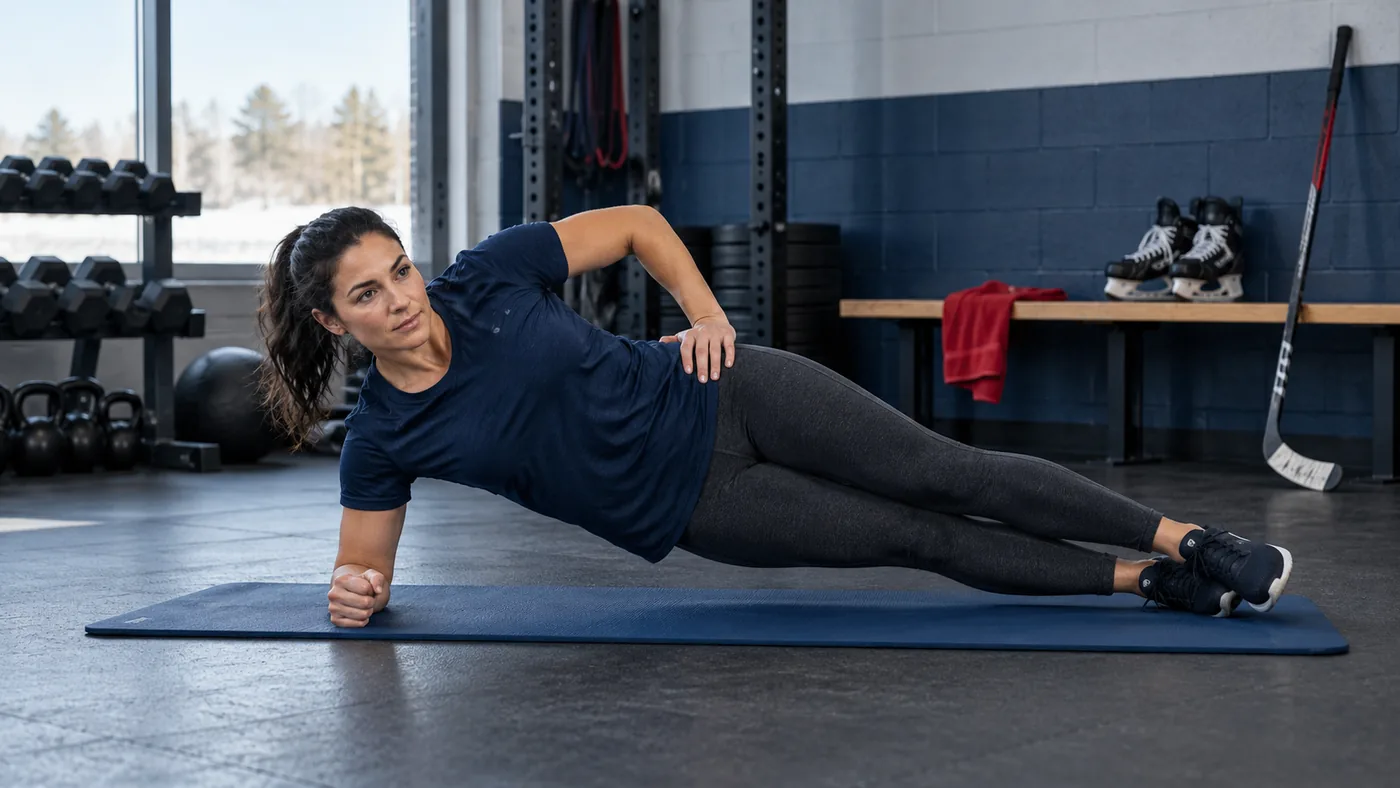
Endurance over maximum effort. Your back is not failing under one heavy rep. It is failing in the third period of the second game of the weekend. Side planks, dead bugs, carries held for time — things that ask a muscle to keep working — fit that problem better than crunches do.
Resist movement rather than create it. Most of what the trunk does in hockey is stop you folding sideways when somebody leans on you, and stop you twisting when you shoot. Pallof presses, suitcase carries, anti-rotation holds. A crunch trains the one thing the sport does not ask for: repeated flexion of a spine that spent the whole game flexed already.
Do not skip the hips. Skating leaves hips tight at the front and weak into extension, and the low back tends to pay for whatever the hips will not do. Glute work and hip flexor length belong in a back programme even though neither is a "core" exercise.
None of that needs equipment or much time, which is the only reason it gets done in a real week.
One thing not to train through
This is the part I would want a parent to read twice.
Back pain in an adolescent athlete is not the same problem as back pain in a thirty-eight-year-old beer leaguer. Young athletes are at higher risk than non-athletes of a stress injury to the pars, a small piece of bone in the back of the vertebra — spondylolysis. It is a common finding in adolescent athletes who present with back pain, and it involves the lowest lumbar vertebra over ninety per cent of the time. It often shows up as pain that is worse when the back arches backwards.
I am not a clinician and this is not a diagnosis. But the practical rule is worth stating plainly: a young player whose back has hurt for weeks, particularly with arching, should be looked at by somebody qualified rather than handed a core programme. Strengthening will not fix a bone that is trying to heal, and the window to treat it well is not indefinite.
For everybody else — adults, ordinary grumbling backs, nothing alarming — moving more is almost always the right instinct, and resting completely is almost always the wrong one.
Where I am honest about the limits
The core-versus-general meta-analysis is five trials and 414 people, which is not a lot. "Core strength" is defined differently in nearly every study that measures it, which makes pooling them awkward.
The prevalence figures come from professional players. Your beer league team, and your thirteen-year-old, are not that population.
And every bit of this is about groups, not about you. A finding that core-specific work gives no advantage at twelve months across hundreds of people does not tell you that it will not help your particular back this winter.
What I am confident about: the difference between training and not training is large and well supported. The difference between one style of training and another is small and fades. Spend your worry accordingly.
Where I land
Do core work. Just do it for the right reason, and in the right shape.
The reason is not that your abdominals brace your spine like a belt. It is that people who train regularly have fewer episodes and shorter ones, and core work is a convenient, equipment-free place for that habit to live.
The shape is endurance, anti-rotation and hips, in short sessions, most weeks of the year — including the part of the year when nothing hurts, which is the part everybody skips.
Rink Ready puts that work into the week rather than leaving it as an optional extra, and there is a daily stretching sheet among the free printables at rinkreadytraining.com/free if a piece of paper on the wall is more your thing. But the principle stands whatever you use: a back programme you do twice a week for a year beats a perfect one you do for three weeks in September.
Sources
- "Comparative Risk Analysis of Low Back Pain among Professional Football, Ice Hockey, and Floorball Athletes" — football n = 148, 42.6% prevalence; ice hockey n = 179, 60.1%; floorball n = 61, 49.2%. Ice hockey OR 2.18 (95% CI 1.45–3.29, p ≤ 0.001); football OR 0.49 (95% CI 0.32–0.74, p ≤ 0.001); floorball OR 0.82 (95% CI 0.47–1.41), not significant. Read it · and here
- "A Meta-Analysis of Core Stability Exercise versus General Exercise for Chronic Low Back Pain", PLOS ONE — 5 randomised trials, 414 participants. Pain at ≤3 months MD −1.29 (95% CI −2.47 to −0.11, p = 0.003); disability at ≤3 months MD −7.14 (95% CI −11.64 to −2.65, p = 0.002); pain at 6 months MD −0.50 (95% CI −1.36 to 0.36, p = 0.26); pain at 12 months MD −0.32 (95% CI −0.87 to 0.23, p = 0.25). Read it
- "Exercises for prevention of recurrences of low-back pain", Cochrane Database of Systematic Reviews — 9 studies, 1,520 participants. Post-treatment exercise versus no intervention: recurrence rate at one year RR 0.50 (95% CI 0.34–0.73), moderate quality evidence; number of recurrences MD −0.35 (95% CI −0.60 to −0.10); days on sick leave MD −4.37 (95% CI −7.74 to −0.99), very low quality evidence. Read it · and here
- "Back pain in adolescent athletes: a narrative review", Orthopedic Reviews — adolescent athletes are at higher risk of spondylolysis and spondylolisthesis than non-athletes; spondylolysis is a common finding in adolescent athletes presenting with back pain and involves L5 over 90% of the time; it often presents as low back pain in extension. Read it