
Running or the bike?
1 October 2026 · Rink Ready
The standard advice is to cycle, because it is closer to skating and it will not blunt your power. I went looking for the evidence and it mostly is not there.
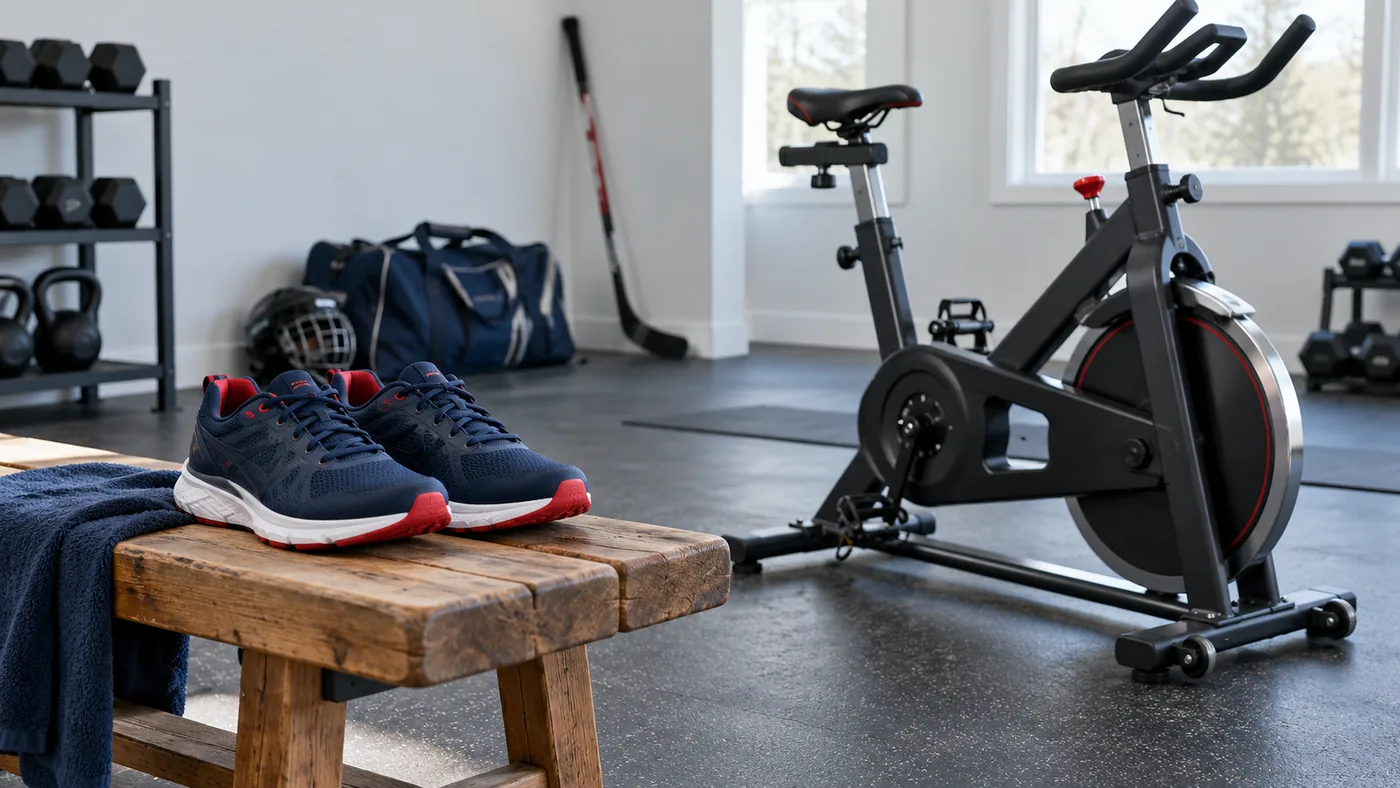
Every year around now somebody asks me the same question. Getting ready for the season, wants to build a base, has about three months. Run or ride?
And there is a standard answer, which you have probably heard. Ride. Cycling is closer to the skating stride, the joint angles line up better, and running will blunt the explosive power you spent the summer building. Bikes are specific and safe; running is generic and costly.
I have repeated a version of that advice myself. So I went and looked for what it rests on, and I came back less certain than I went in.
First, what the season actually asks for
Hockey is not an endurance sport and it is not a sprint sport. It is a sequence of short violent efforts with incomplete recovery, repeated for an hour, three times a week, for six months.
That shape has a consequence people find counterintuitive: the thing that limits you late in a shift, and late in a game, is largely aerobic. Not because you need to skate for twenty minutes without stopping, but because the aerobic system is what pays back the debt between shifts. Players with higher aerobic capacity hold their repeated-sprint performance together better than players without it.
And a related finding from the same work, which is worth sitting with: off-ice anaerobic power turned out to be a poor predictor of on-ice repeated-shift performance. The test everybody uses to prove they are in hockey shape does not predict the thing it claims to.
So you do want an aerobic base. The question is only what you build it with.
The case for the bike, and what is wrong with it
Two arguments are usually made. Both are weaker than they sound.
"Running will kill your power." This is the interference effect, and it is real, but it is narrower than gym folklore suggests. The best current synthesis pooled 43 studies and 1,090 people. Maximal strength: no significant reduction. Muscle size: no significant reduction. Explosive strength: yes, a real and significant attenuation.
That last one matters to us, because explosive is exactly what hockey is. But notice what the finding does not say. When the researchers split the studies by what kind of cardio people did, the significant effect showed up in the cycling group, not the running group — and then disappeared entirely once one outlying study was removed. Their conclusion was that the type of aerobic training did not meaningfully change the interference.
Read that again if you have been told to get off the treadmill and onto the bike to protect your legs. The evidence does not support the swap. It supports watching your total volume of steady-state work, whichever machine you do it on.
"Cycling is more specific to skating." This is the one I expected to hold up, and it is the one that surprised me.
A study of male youth hockey players ran 33 off-ice tests against on-ice performance. Sprint running tests — 30 metre time, top speed — were among the most consistent predictors of skating speed, acceleration and agility. The Wingate cycle test, the standard off-ice power measure in hockey for decades, showed no significant correlation with any on-ice variable in its absolute power measures.
One study, one age group, and a correlation is not a training effect — more on that below. But if cycling really were the mechanically closer match, that is not the result you would expect.
The case for running, including one you have not heard
The obvious ones first: it costs nothing, needs no equipment, and you can do it anywhere, which matters more than any of this when the real competitor is not doing it at all.
The less obvious one is bone.
Skating is a strange loading environment. There is enormous muscular force and almost no impact — the blade never strikes the ground the way a foot does. A twelve-year follow-up compared young male badminton players with young male ice hockey players. The badminton players ended up with significantly higher bone density at the femoral neck, the humerus, the lumbar spine and the legs. The authors put it plainly: badminton is a more osteogenic sport than ice hockey.
Both groups lost bone after they retired, but the badminton players kept an advantage years later.
Your sport builds a lot of things. Dense bone is not obviously one of them. Running is one of the few cheap ways to add the impact loading that skating does not provide — which lines up with the public guidance for under-eighteens, where bone-strengthening activity on three days a week sits alongside the aerobic minutes as a separate requirement.
The real cost of running, which is not your gains
Running does carry a cost. It is just not the one usually named.
It is impact tolerance. A player who has skated all winter, sat all summer, and then starts running four times a week in September is loading tissue that has not been loaded in months. Shins, achilles, knees. That is a volume-progression problem, and it is solved by progressing slowly rather than by buying a bike.
The second cost is that neither running nor cycling does anything for the groin. Hockey's signature injury is an adductor strain, and both of these move you forwards in a straight line. Whatever you choose, it is not addressing the thing most likely to end your season.
What actually matters more than the machine
Here is where I have ended up.
The shape of the session matters more than the equipment. Hockey is intervals with incomplete recovery. Thirty to forty-five seconds hard, a couple of minutes easy, repeated — that is the season in miniature, and you can run it or ride it. A steady forty-minute effort at one pace, on either machine, trains something the sport does not ask for.
Some easy aerobic volume is still worth having underneath the intervals, because that is what builds the recovery engine. But the interval work is the part that looks like a hockey game.
And if you are doing a lot of long steady-state work of either kind alongside your lifting, that is the scenario where explosive strength takes the hit. Not because you ran, but because of how much.
Where I am honest about the limits
There is no study that took two groups of hockey players, ran one and cycled the other for a summer, and measured what happened on the ice in October. I looked. If it exists I could not find it.
So everything above is assembled from adjacent evidence — what the sport demands, what interferes with what, which tests predict skating, how bone responds — and assembled evidence is weaker than a direct trial. A test correlating with skating does not prove that training in that pattern improves skating. I am confident about the direction and not about the size.
What I am confident about is the negative. The two reasons usually given for choosing the bike over running do not hold up well, and anybody telling you this is settled has not read the same things I have.
So what would I actually do
Both, mostly, and neither for very long at a time.
Run the intervals if you have somewhere safe to run and no injury history telling you otherwise — it is free, it loads bone, and the sprint-style qualities it trains are the ones that showed up against skating. Ride when your legs are beaten up, when the weather is foul, or when you want aerobic volume without adding impact to a week that already has three skates in it.
Pick by what you will actually do four times a week in November, because a perfectly specific session you skip is worth nothing, and a decent session you do is worth a lot.
If it helps, Rink Ready has conditioning sessions grouped by how much time you actually have rather than by what you own, and both indoor and outdoor versions are among the free printable sheets at rinkreadytraining.com/free — no account, no email. But the principle stands whatever you use to run it.
Intervals. Progress slowly. Do something for your groin. And stop worrying about which machine.
Sources
- "Compatibility of Concurrent Aerobic and Strength Training for Skeletal Muscle Size and Function: An Updated Systematic Review and Meta-Analysis" (Schumann et al.), Sports Medicine — 43 studies, 1,090 participants. Maximal strength SMD −0.06 (p = 0.446); hypertrophy SMD −0.01 (p = 0.919); explosive strength SMD −0.28 (p = 0.007). Modality subgroup: cycling −0.44 (p = 0.043), not significant after removing an influential outlier (−0.27, p = 0.086); modality did not significantly moderate the effect. Read it · and here
- "The relationship between off-ice testing and on-ice performance in male youth ice hockey players", Frontiers in Sports and Active Living, 2024 — 24 of 33 off-ice variables correlated with on-ice performance; 30 m sprint measures among the most consistent predictors; Wingate absolute power measures showed no significant correlation with any on-ice variable. Read it
- "Effects of badminton and ice hockey on bone mass in young males: A 12-year follow-up", Bone — badminton players had significantly higher BMD than ice hockey players at the femoral neck (0.06 g/cm², p = 0.04), humerus (0.06, p = 0.01), lumbar spine (0.08, p = 0.01) and legs (0.05, p = 0.003); "badminton is a more osteogenic sport compared to ice hockey". Read it
- "Repeated Sprint Ability: The influence of aerobic capacity on energy pathway response and fatigue of hockey players" (Peterson), University of Minnesota — players with higher VO2peak showed better repeated-sprint performance; off-ice anaerobic power was not a good predictor of on-ice repeated-shift performance. Read it
- CDC, Physical Activity Guidelines for children and adolescents aged 6–17 — bone-strengthening activity on at least 3 days a week, listed separately from the aerobic requirement. Read it