
Something hurts. Now what?
13 October 2026 · Rink Ready
Sitting out until it stops hurting is the most expensive thing you can do with a minor injury. The evidence for carrying on around it is better than I expected, and the evidence for one particular trick is better than almost anyone knows.
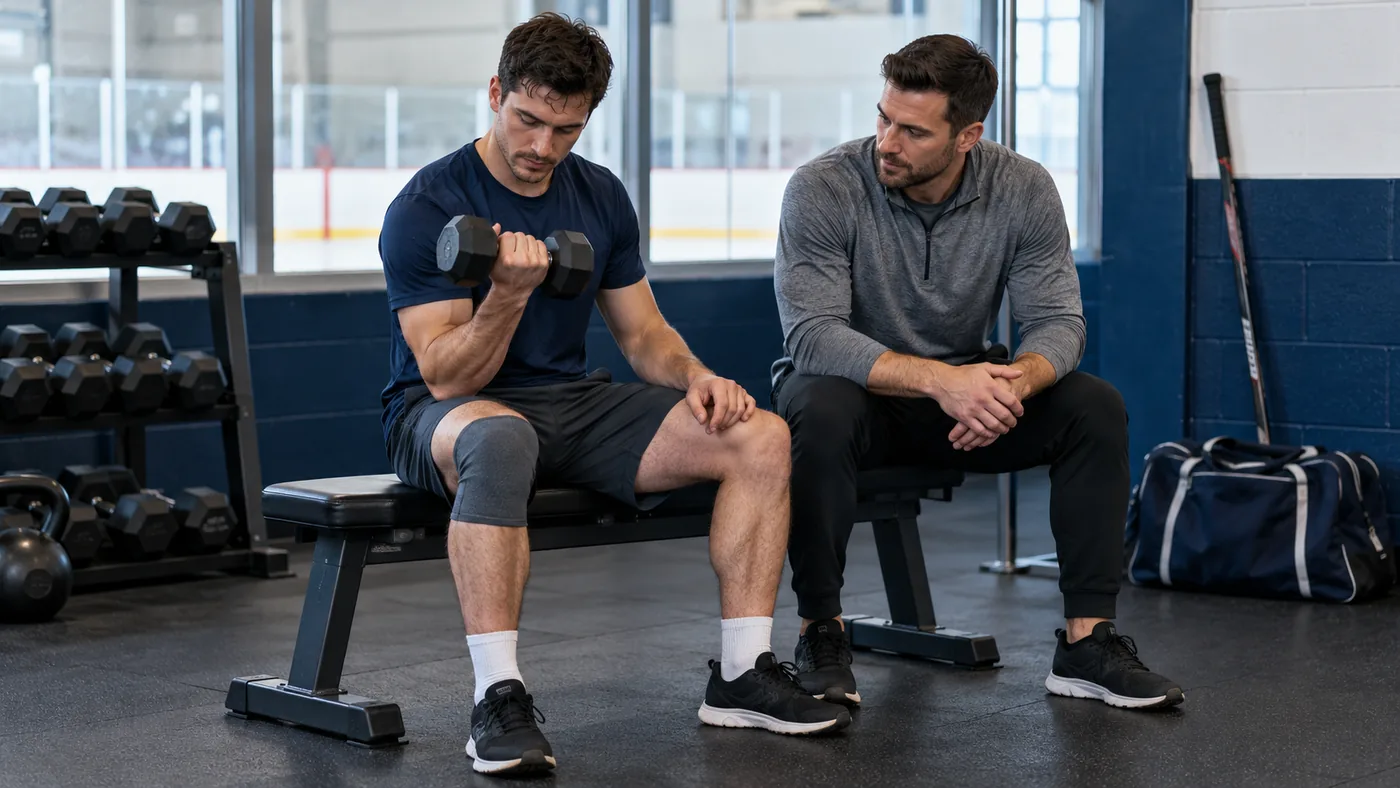
My son tweaked something in his groin in September and did what every kid does. He said nothing for four days, moved a bit oddly, and then admitted it when he could not do a crossover.
And then we hit the part nobody has a good answer for. Not the injury — the week after it. He was not hurt enough for a doctor and he was too hurt to train normally, and the only instruction either of us had ever been given for that situation was rest it.
So he rested it. He did nothing for eleven days. And at the end of those eleven days his groin felt fine and everything else about him was worse.
I have since gone looking for what the advice rests on, the way I did with the bike and the compression boots, and I came back with something that genuinely changed how I train and how the app works.
The instruction changed and nobody told us
Most of us learned RICE. Rest, ice, compression, elevation. It has been on posters in every rink in North America since the late seventies.
The people who write the guidance have moved on from it. The current framing in sports medicine is PEACE and LOVE, published in the British Journal of Sports Medicine in 2020. The first few days are PEACE — protect it, elevate it, compress it, and, awkwardly for the posters, avoid anti-inflammatories, on the grounds that the inflammatory response is part of how tissue repairs and blunting it may not help.
After that it becomes LOVE, and the L is the one that matters here. L is for Load. The guidance is that early movement promotes healing, that mechanical loading should come back as soon as symptoms allow, and that some discomfort during activity is acceptable so long as it settles afterwards.
Read that again, because it is the opposite of what we tell kids. The instruction is not wait until it stops hurting. The instruction is start putting load back through it before it stops hurting, and use how it feels afterwards as the test.
I am not going to pretend an acronym is a clinical trial. It is a consensus framing, not an experiment. But it is the framing the field moved to, and it is a long way from a poster that says rest.
What rest actually costs you
Here is where I expected to find a hard number and did not.
The best systematic review I could find on what detraining does to strength pulled together twenty trials and concluded, honestly, that there is not enough good evidence to say reliably how long training gains last once you stop. That is not the answer anyone wants, and it is the answer.
What it could say is this. In the two studies they could pool, strength after sixteen to twenty-four weeks of doing nothing was still meaningfully above where people started. It took somewhere between thirty-two and forty-eight weeks before strength came back down to untrained levels. Muscle size went much faster than strength did — in one study, cross-sectional area was back to baseline at twelve weeks while strength was still about 12% above where it began.
So the honest version is not "you lose it in two weeks." Eleven days off is not a catastrophe and anybody who tells a thirteen-year-old otherwise is selling something.
But that is strength measured in a laboratory, on the one thing that got tested. It is not the habit, it is not the skill, and it is not the Tuesday night where he found out that doing nothing is quite comfortable. The thing that eleven days actually cost my son was not his squat. It was the eleven days.
The one I did not expect
This is the part that made me rebuild something.
If you train one limb, the untrained limb on the other side gets stronger. Not a bit stronger — meaningfully stronger, without being trained at all. It is called cross-education, it has been known about for over a century, and most people who coach have never heard of it.
The size of it, across the studies in a 2025 review: gains of roughly 12 to 28% in an untrained upper limb and 15 to 35% in an untrained lower limb. One study in there found the effect appeared after training at 75% of a one-rep max but not at 25%, which suggests it needs real intent, not a token effort.
And the version that matters when something is actually hurt: a meta-analysis of the studies done on immobilised limbs found a pooled effect on strength of 1.60 — a large effect — with a confidence interval that stays on the right side of zero, and a similar result for muscle thickness.
The authors of that meta-analysis are careful, and I will be too: it is five trials, the heterogeneity is high, and they rate the risk of bias in the included studies as high. Read it as a strong signal rather than a settled number.
But the direction is not in doubt, and the practical version is startling. If a kid has one leg in a boot, training the other leg is not a consolation prize. It is doing measurable work on the leg in the boot.
What this does not mean
I want to be careful here, because "keep training" is exactly the kind of advice that gets twisted.
None of the above applies to a fracture, a joint that gives way under you, pain that wakes you at night, numbness, pins and needles, or anything that followed a proper collision. Those need somebody who can put hands on it, and the only correct thing an app can do with them is get out of the way.
What it applies to is the enormous ordinary middle: the tweaked groin, the sore shoulder, the back that complains after a bad landing. The injuries nobody takes to a clinic and nobody knows what to do with.
And the thing to understand about that middle is that the default — sit out until it feels normal — is a choice, not a neutral absence of one. It is the choice with the worst evidence behind it.
The hockey-specific footnote
While I was in the literature I went back to a study I have cited before, because it belongs here.
In 2002, a group tested every player on an NHL team before the season and identified the ones whose hip adductors were weak relative to their abductors. Thirty-three of the fifty-eight were flagged. Those players did a preseason adductor strengthening programme.
Over the two seasons that followed there were three adductor strains, a rate of 0.71 per thousand player-game exposures. Over the two seasons before, on the same team, there had been eleven, at 3.2 per thousand.
It is not a randomised trial — the comparison is the same team's own history — so hold it loosely. But a roughly four-fold difference in the single most common hockey injury, from an exercise programme, is not nothing. The groin is the thing. If you train around a hockey player's injuries for long enough you learn that most of them have an adductor story.
So I built the thing I wanted in September
Everything above is why RinkReady has an injury mode rather than a pause button.
You tell it what hurts. Every exercise in your week that loads that area gets flagged, and each one is offered a safe alternative or a skip. Nothing is deleted and nothing is decided for you — you can leave an exercise flagged and judge it on the day, which is what the load guidance actually asks you to do. The rest of the week stands exactly as it was.
It also keeps it. Turning injury mode off does not throw the record away; the area, the dates and how long it lasted are kept, because "my groin, every February" is a pattern and you cannot see a pattern in a field that only ever holds today.
And one thing I got wrong, which is worth telling you about. Every area in it was a muscle — quads, glutes, hamstrings, lower back. Then I bruised my tailbone, flagged the nearest honest match, and watched the app leave all eight of the week's bike sessions standing, because a bike is tagged quads and nothing in that tagging knew I would be sitting on a saddle. A muscle is not the only way an exercise can hurt you. There is now a group of areas in there that are positions rather than muscles, and the bike gets caught.
That is the whole product, and it is not very clever. It is just the alternative to the only two options a kid is usually given, which are carry on and make it worse, or stop and lose the month.
Something hurts. You train around it. That is it.
Sources
- Dubois B, Esculier JF. "Soft-tissue injuries simply need PEACE and LOVE." British Journal of Sports Medicine 2020;54(2):72–73. The origin of the PEACE and LOVE framing. L is for Load: early movement and mechanical loading promote healing; discomfort is acceptable if it settles. PEACE includes avoiding anti-inflammatories in the first days.
- Ferreira-Junior JB et al. "Effects of Detraining on Muscle Strength and Hypertrophy Induced by Resistance Training: A Systematic Review." Muscles (MDPI) 2022;1(1):1. Twenty trials; only two could be pooled for 1RM strength. After 16–24 weeks of detraining strength remained significantly above control (chest press Hedges' g = 1.99; leg press g = 3.16); at 32 and 48 weeks it no longer differed. One study: cross-sectional area back to baseline at 12 weeks with strength still ~12% above baseline. The authors state there is insufficient high-quality evidence to say reliably how long gains last, and rate the included studies at high or moderate risk of bias.
- Haggert M, Pearce A, Frazer A, Rahman S, Kidgell D, Siddique U. "Determining the Effects of Cross-Education on Muscle Strength, Thickness and Cortical Activation Following Limb Immobilization: A Systematic Review and Meta-Analysis." Journal of Science and Medicine 2020;2(4):1–16. Five randomised controlled trials. Strength SMD 1.60 (95% CI 0.62 to 2.59, P = 0.001, I² = 70%); muscle thickness SMD 1.52 (95% CI 0.22 to 2.81, P = 0.02, I² = 86%). The authors describe the estimates as preliminary given the small number of trials and high risk of bias.
- Mirto A et al. "Cross-Education of Strength: From Theory to Practice in Contemporary Sports Rehabilitation — A Narrative Review and Clinical Implications." Sports Medicine – Open 2025;11:129. Reported contralateral strength gains of 12.5–28.1% in the upper limb and 15–35% in the lower limb across the cited studies. One cited study found the effect after training at 75% 1RM but not at 25% 1RM. A narrative review, not a pooled analysis.
- Tyler TF, Nicholas SJ, Campbell RJ, Donellan S, McHugh MP. "The effectiveness of a preseason exercise program to prevent adductor muscle strains in professional ice hockey players." American Journal of Sports Medicine 2002. Thirty-three of fifty-eight players on one NHL team were identified as at risk on preseason adductor strength and completed the programme. Three adductor strains over the two intervention seasons (0.71 per 1000 player-game exposures) against eleven over the two previous seasons (3.2 per 1000). The comparison is the same team's own injury history, not a concurrent control group.
Notes on what this claims
This piece is about the ordinary middle of injury — the tweaks and the soreness nobody takes to a clinic. It is not about fractures, joints that give way, night pain, numbness or anything that followed a collision, and nothing in it should be used to decide whether an injury needs looking at. If you are not sure, that is itself the answer: go and find out.
I am a hockey parent who reads papers, not a clinician. Where the evidence is thin I have said so rather than rounded it up.