
The RinkReady Gear-Sizing Guide
5 October 2026 · RinkReady
ear that fits protects better, moves better, and lasts longer — and most fit problems come from buying by age or by the size you wore last season. This guide walks through how to measure a player and how to check each piece on their body, f
Use it in three steps: take the measurements below, use the brand's size chart to pick a starting size, then confirm the fit with the hands-on checks in each section. Brand charts vary, so the fit check always wins over the label.
Before you measure
Eight quick measurements cover almost every size chart. Take them with a soft tape measure, in socks and a thin base layer, ideally late in the day when feet are at their largest.
- Height — Barefoot, against a wall. Used for: Pants, shoulder pads, stick length.
- Weight — Standard scale. Used for: Shoulder pads, pants (secondary).
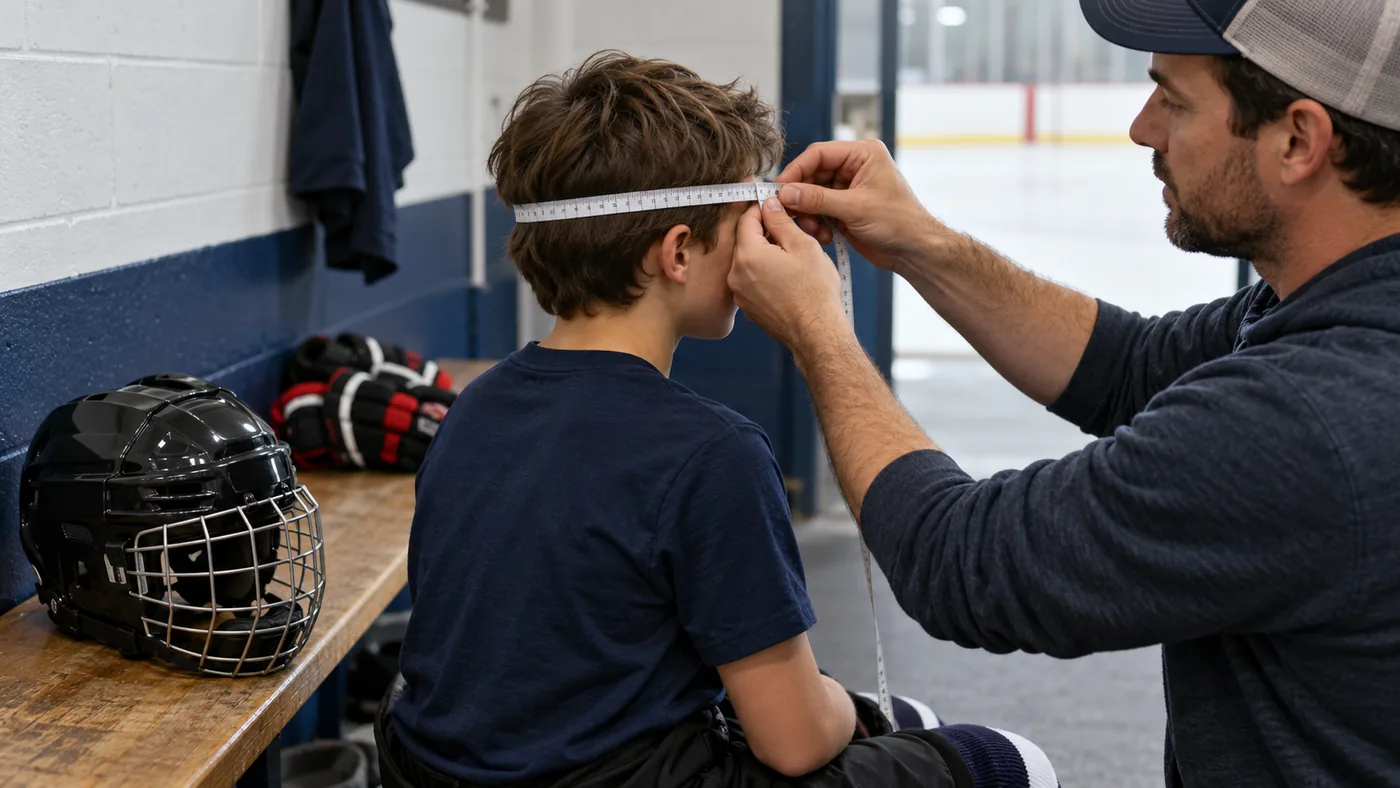
- Head circumference — Tape about 1 in (2.5 cm) above the eyebrows, around the widest point. Used for: Helmet.
- Chest — Around the fullest part, under the arms. Used for: Shoulder pads.
- Waist — Around the natural waist, at the belly button. Used for: Pants, jock/jill.
- Foot length and width — Heel against a wall, mark the longest toe; measure both feet. Used for: Skates.
- Shin length — Center of the kneecap to the top of the skate boot (or ankle bend). Used for: Shin guards.
- Arm (elbow to fingertips) — Bent elbow, measure to the tip of the middle finger. Used for: Gloves, elbow pads.
Always size to the larger foot or the bigger measurement. Bring the player's skates and current gear when trying on new pieces, since each one has to work with the others.
Skates
Hockey skates usually run 1 to 1.5 sizes smaller than street shoes, so never order by shoe size alone. Start from the brand's foot-length chart, then confirm with these checks:
- Length: Unlaced, slide the foot forward until the toes just touch the toe cap. You should fit no more than one finger (about 1/4–1/2 in) behind the heel. When laced and standing in a knee bend, toes should lightly brush the cap, not curl.
- Heel lock: Lace snugly and lift the heel. It should not rise inside the boot. Heel slip causes blisters and lost power.
- Width: Feet should feel evenly hugged, with no pinching at the sides or pressure on the outside of the little toe. Most brands offer narrow, regular and wide fits (labels like D/EE or Fit 1/2/3).
- Ankle and tongue: The ankle should sit in the boot's pockets without gaps, and the tongue should stay centered.
- Wear time: Stand and flex in them for 10–15 minutes in the shop. Pain that shows up then will be worse on the ice.
Heat-moldable boots can be baked for a custom fit; follow the brand's instructions or have a pro shop do it. For kids, resist buying more than a half size up for growth — extra room makes skating harder and less stable.
Helmet and cage
The helmet is the one piece with no room for "grow into it." Pick the size from head circumference, adjust it, then check:
- Snug all around: No gaps between the padding and the head at the front, sides or back. Shaking the head shouldn't move the helmet.
- Brow position: The front rim sits about one finger-width above the eyebrows.
- Chin strap: One finger fits between the strap and the chin; the strap's cup sits on the chin, not under it.
- Cage or shield: The chin cup rests on the chin when the strap is fastened, and the player has a clear view straight ahead and to the sides.
Use a helmet and cage certified for hockey (in North America, look for HECC and CSA stickers), and replace either after a hard impact, if the shell cracks, or when the certification date expires.
Shoulder pads, elbow pads and gloves
Upper-body gear should cover without gaps and move without riding up. Try all three on together, with the jersey over the top.
Shoulder pads are sized by chest and height.
- Shoulder caps sit directly over the points of the shoulders.
- The chest plate covers the sternum and the back plate covers the shoulder blades.
- Bottom edge meets the top of the pants with little or no gap.
- Raising both arms overhead shouldn't push the pads into the neck or chin.
Elbow pads are sized by the arm measurement.
- The elbow sits centered in the pad's cup.
- The upper end meets the bottom of the shoulder-pad bicep guard; the lower end meets the glove cuff.
- Straps hold the pad in place through a full bend and straighten without sliding.
Gloves are sized in inches (roughly 8–11 in youth, 12–15 in adult).
- Fingertips sit about 1/4 in from the ends of the fingers, with no jamming when making a fist.
- The cuff overlaps the elbow pad, leaving no bare forearm.
- Wrists bend freely enough for stickhandling and shooting. Gripping a stick in the shop is the best test.
Pants, shin guards, jock/jill and neck guard
Pants are sized by waist, with height as a tiebreaker.
- The waist sits at the natural waist and stays up with a belt or suspenders.
- Thigh guards cover the front of the thighs; the bottom hem reaches the top of the kneecap.
- Kidney and tailbone pads line up with the body when the player is in a crouch.
- The top overlaps the bottom of the shoulder pads by about 1–2 in.
Shin guards are sized by shin length in inches.
- The kneecap sits centered in the knee cup.
- The bottom of the guard ends at the top of the skate boot, so the skate tongue can sit over or behind it (player's preference) without gaps.
- Put skates on before judging fit; a guard that's too long gets pushed up by the boot.
Jock/jill is sized by waist and should sit snug without pinching; it holds up the socks with velcro tabs, so check those reach.
Neck guard (required in many youth leagues) should cover the throat fully, close comfortably, and not ride up into the chin.
Sticks
A stick is sized by three things: length, flex and curve. Get length and flex right first; curve is personal preference.
- Length: In skates, with the stick upright and the toe on the ice, the butt end should reach between the chin and the nose. Without skates, aim for between the nose and the eyebrows. Shorter favors stickhandling; longer favors reach and slap shots. Defense often plays a bit longer than forwards.
- Flex: A common starting point is about half the player's body weight in pounds (a 100 lb player starts near a 50 flex). Cutting a stick shortens it and makes it stiffer — roughly 5 flex points stiffer per inch removed, depending on the brand.
- Curve and hand: A player who holds the stick with the left hand at the bottom uses a left-handed stick. Beginners do best with a mild, mid-heel curve that's easy to pass and receive with.
For young players, a flex that's too stiff is the most common mistake. If the stick doesn't bend on a wrist shot, it's too stiff.
Quick-reference fit check
Print this or keep it on your phone for the pro shop.
- Skates — Foot length + width. It fits when: Toes brush the cap in a knee bend; heel stays locked. Red flag: Heel lifts, toes curl, side pinching.
- Helmet — Head circumference. It fits when: Rim one finger above brows; no movement when shaking head. Red flag: Gaps at sides, tilts back.
- Shoulder pads — Chest + height. It fits when: Caps on shoulder points; meets pants. Red flag: Pads hit chin with arms up.
- Elbow pads — Arm length. It fits when: Elbow centered in cup; meets glove cuff. Red flag: Slides down when bending.
- Gloves — Hand/arm length (in). It fits when: Fingertips 1/4 in from ends; cuff overlaps elbow pad. Red flag: Bare forearm showing.
- Pants — Waist + height. It fits when: Hem at top of kneecap; overlaps shoulder pads. Red flag: Sagging, gap at the hip.
- Shin guards — Shin length (in). It fits when: Knee centered in cup; ends at skate top. Red flag: Pushed up by the boot.
- Stick — Height + weight. It fits when: Butt end chin–nose in skates; bends on a wrist shot. Red flag: Too stiff to flex.
Growing players and common mistakes
Re-check a young player's fit at the start of every season and again at midseason. Kids can outgrow skates in a few months, and gear that fit in September may leave gaps by February.
Signs it's time to resize:
- Toes jam the skate cap or the player complains of foot pain.
- Gaps appear between pieces (pants and shoulder pads, glove cuff and elbow pad).
- The helmet won't close snugly at the largest adjustment.
- The stick reaches below the chin in skates.
The most common sizing mistakes:
- Buying too big to grow into. Loose gear shifts on impact and leaves skin exposed. Size for now, with at most a little room in pants and shoulder pads.
- Ordering skates by shoe size. Always measure the foot and use the brand's chart.
- Skipping the full-kit try-on. Each piece has to overlap the next, so check them together.
- Using a stiff adult stick for a kid. Match flex to body weight, not to a favorite player's stick.
- Keeping a helmet past its date. Check the certification sticker every season.
When in doubt, bring the player in and get fitted in person — a 20-minute fitting beats a season of blisters.