
Why We Love a Sport That Makes it This Hard
25 September 2026 · Perry
Nobody drives ninety minutes at five in the morning for something they only half like. That is most of the answer.
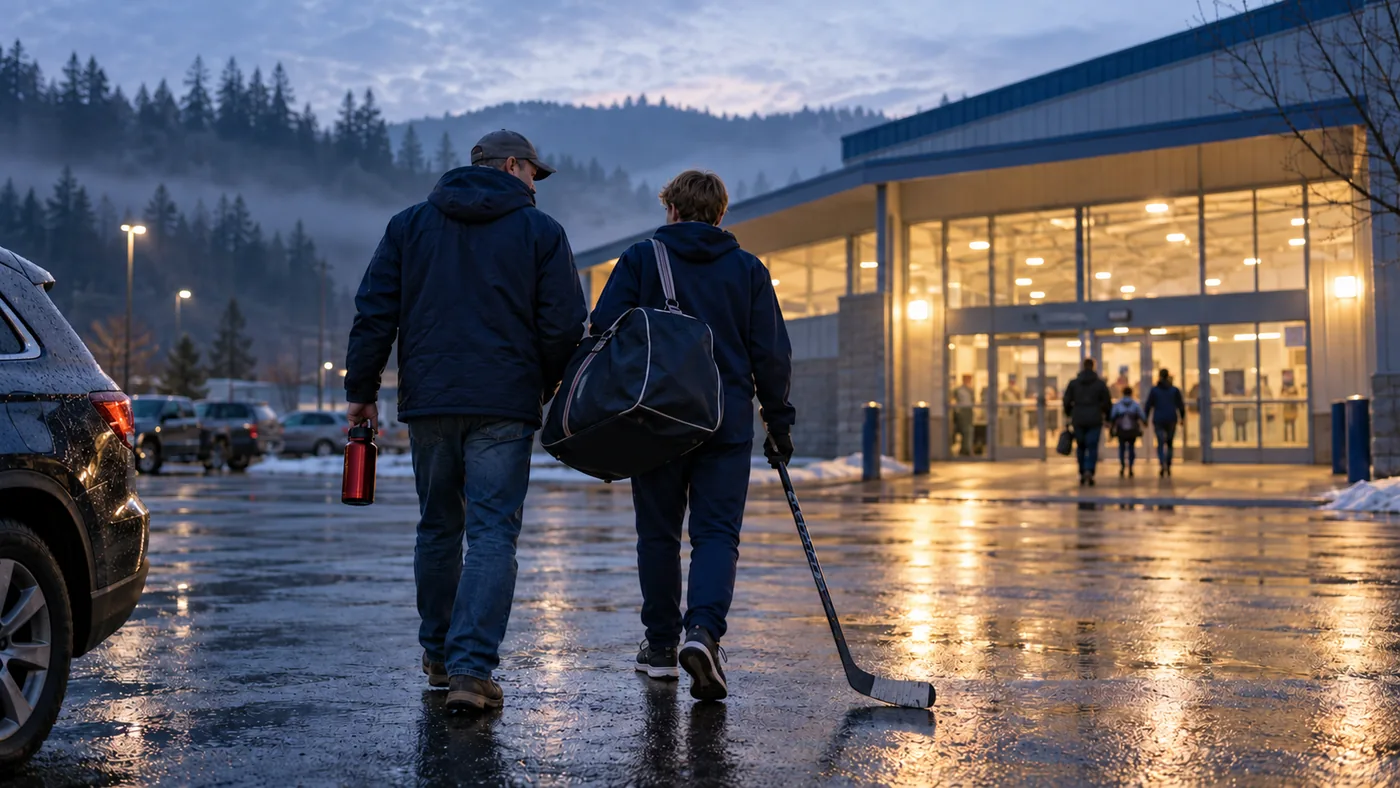
There is no ice in Roseburg. If your kid plays, you already know what that means: an hour up the freeway to Eugene, or an hour and a half the other way to Medford, in the dark, with a bag in the back that never quite dries out.
Nobody does that for a sport they half like. So it is worth saying out loud what it is we actually love, because it is not the thing people outside the game assume.
You have to learn to move before you can learn the game.
Every other sport starts with running. You already know how to run. You show up to soccer or basketball at six years old and the first thing you are asked to do is something your body has done since it was two.
Hockey starts by taking that away. Before a kid can play at all, they have to learn a way of moving that nothing else in their life has taught them, on a surface that will not hold still, with knives on their feet. For the first year the sport is not a sport. It is falling over.
What that does to a kid is the whole point. They learn, early and in their body rather than from a poster, that being bad at something is a stage and not a verdict. That is worth more than a trophy and it lasts longer.
It is the only game you can change in the middle of.
Football stops. Basketball stops. Soccer makes a ceremony of it. Hockey lets five people come off and five go on while the play is still running, and expects everyone to sort it out at speed without anybody telling them to.
Watch a good bench and you will see something that does not really exist anywhere else in sport: a team doing the boring, unselfish, invisible work of covering for each other, forty-five seconds at a time, all night. Nobody claps for a clean change. Everybody notices a bad one.
That is also why hockey finds a place for almost any kid. There is a job for the one who is quickest, and a job for the one who is not quick but never stops, and a job for the one who will stand in front of a shot. A team that only wants one type of player is a team that loses in March.
The drive is not the price of it.
You would think the travel is what we put up with in order to get the hockey. Ask any family in the car at half five and you will get a more complicated answer.
Those drives are where the conversations happen. Not the ones you plan — the ones that turn up somewhere around Cottage Grove because you have both run out of other things to say. A teenager will tell you things at six in the morning on I-5 that you would never get out of them at the kitchen table.
The tournament hotel is the same. Bad breakfast, damp gear on every radiator, somebody's dad trying to find a laundromat. Ten years later that is what they remember, and it is not really about hockey at all.
Then everybody shakes hands.
Whatever happened in the sixty minutes before it, both teams line up and every single player shakes every single hand. Kids who were genuinely angry two minutes ago. Nobody skips it. Nobody makes a thing of it.
There are not many places left that teach that, and none that teach it that plainly.
Which brings me to the garage floor.
All of which is why the boring part matters. Ten minutes of stickhandling on a Tuesday, a set of squats in the garage, landing a jump properly so a knee lasts the season — that is not separate from the thing we love. It is how a kid...and adults, gets to keep doing it.
The sheets on this site are free for exactly that reason. Take whichever one fits your week.